Why Mountain Terraces Turn Slopes into Gardens
Mountain terraces turn steep slopes into usable gardens by following local contours, shaping level plots and making water and access part of the design.
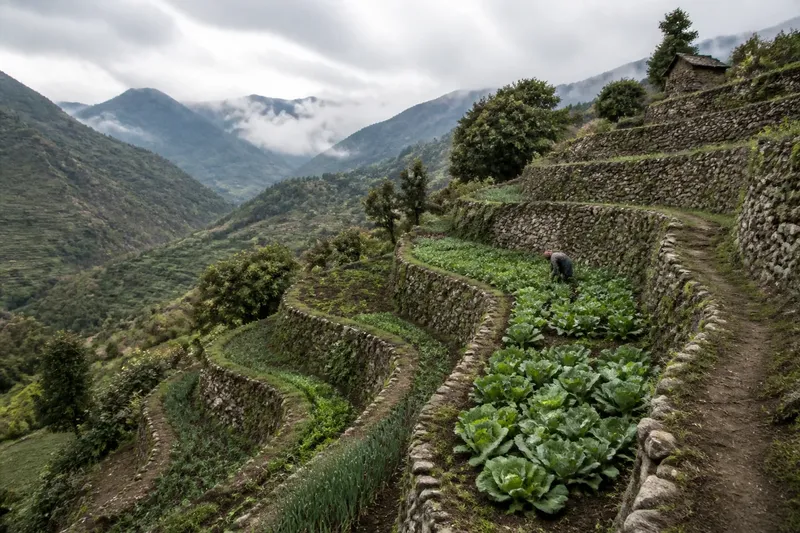
On a mountain path, a garden may appear as a green ribbon tucked between stone walls, each narrow strip following the hillside rather than cutting straight across it. Mountain terraces turn steep slopes into gardens by creating level growing spaces while responding to the land’s own contours. Their shape is not simply a convenient pattern: it reflects how soil, water, access and available ground meet on a particular slope.
1. The contour sets the line
A contour is a line across a slope that stays at roughly the same elevation. Terrace walls often follow these lines, bending around ridges and shallow hollows instead of imposing a rigid grid. From above, they may look irregular; from within the landscape, their turns make sense.
Following the contour helps keep each growing strip from becoming a steep ramp. It also means a terrace can widen where the hillside offers room and narrow where a spur or rocky shoulder pinches it. The result is a series of level or gently graded plots shaped by the site, not a uniform staircase laid over it.
Look for where a wall curves or changes direction: that turn often records a change in the slope beneath it.
2. The wall holds a level
A terrace needs a boundary where the uphill soil meets the lower edge of a level plot. In many landscapes, that boundary is a retaining wall built from local stone; elsewhere, earth banks, planted edges or a combination of materials do the work. The choice reflects what can be gathered nearby, what the ground can support and how much labour the community can devote to construction and upkeep.
Stone walls may be dry-stacked, with no visible mortar, so their structure depends on the arrangement of individual pieces. Larger stones commonly form the base, while smaller pieces fill spaces and help create a stable face. A wall’s thickness and height vary with the slope and the plot it holds; there is no single terrace-wall pattern suited to every mountain.
The level ground behind a wall is made by balancing cut and fill: soil is moved from the uphill side to build out the lower side. Where the wall meets a natural rock outcrop, the terrace may stop, turn or divide rather than force a straight edge through it.
3. Water shapes the layout
Rain and irrigation follow gravity, so terrace design has to account for where water arrives, where it travels and where it can leave. A plot may be level enough for cultivation yet still need a slight fall, a channel or a designated outlet. The route depends on local rainfall, soil and water traditions. In some places, small channels carry water from one plot to another; in others, drainage paths guide excess water away from walls and growing ground.
Terraces can slow water moving downhill by interrupting the slope with successive plots and boundaries. That does not mean every wall handles water in the same way. A blocked channel or a poorly drained corner can put pressure on a wall, while a planned outlet gives water somewhere to go. The careful observer can often trace the intended route by following channels, gaps and changes in the ground.
Notice where water is meant to leave a plot, not only where it enters.
4. Soil and crops choose the width
Terrace width reflects more than the angle of the hillside. A broad bench may suit crops that need room for several rows, while a narrow strip can make sense where the slope is steep or the soil is shallow. The working space also has to fit the tools and methods used there: a plot tended by hand can be narrower than one that needs room for an animal or larger equipment.
Soil depth matters too. Cutting deeply into a hillside may uncover rock or leave a thin layer that dries quickly. A terrace built around deeper soil pockets may therefore change width along its length. Crop choice can follow those differences: plants that tolerate thinner soil may occupy exposed edges, while crops needing more consistent ground are placed where soil is deeper and easier to tend.
Say you are looking at an invented hillside where a rocky ridge interrupts an otherwise broad slope. A grower might keep the existing ridge, narrow the adjacent plot and use the wider ground below for rows that need more working room. The observable result would be terraces of different widths, with the wall line bending around rock rather than cutting through it.
5. Paths connect the plots
A garden on a slope is useful only if people can reach it. Steps, ramps and narrow paths link terraces, often following the easiest route between plots rather than the shortest straight line. A path may run along a wall, cross a terrace at its end or switch direction where the slope becomes sharper.
These routes affect the shape of the terraces. A passage needs enough room for the people, baskets, tools or animals that use it, and its position can divide one growing area into several smaller plots. Paths also connect fields to homes, water sources and local roads, tying the cultivated slope to everyday life beyond the garden itself.
When a path turns, check what it avoids: a steep face, a wet patch or a change in the terrace level may explain its course.
6. Upkeep leaves visible traces
Terraces are maintained landscapes, not finished structures. Stones may be reset, channels cleared, soil replenished and paths repaired as weather and cultivation alter the ground. The work is often local and incremental, so a terrace can contain walls of different ages or materials beside one another. Such variation may reflect repairs and adaptations rather than a lack of design.
Abandoned plots can change more quickly than their stone edges suggest. Scrub may take root, channels may clog and soil may collect unevenly behind a wall. A terrace that still looks intact from a distance may no longer function as a growing space. Conversely, a modest wall with fresh repairs and a clear path can show that a small plot remains part of the working landscape.
What do mountain terraces reveal?
Why are terraces rarely straight?
They follow contours, rock, soil pockets and existing routes, all of which vary across a slope. Curves and changes in width are often practical responses to those conditions.
How do terraces manage water?
They interrupt the downhill flow and may use channels, gentle falls or outlets to move water through or away from plots. The arrangement differs with local ground and water practices.
Why are some terraces narrow?
A steep slope, shallow soil or restricted space can leave room for only a narrow bench. The working method and the crops grown also influence how much width a plot needs.
Can an old terrace still be a garden?
It can be, if the ground is cultivated and its walls, paths and water routes remain part of use. Stonework alone does not show whether a terrace is still actively maintained.
Reading the hillside
To understand why mountain terraces turn slopes into gardens, follow the lines rather than judging them as a repeated pattern. Notice where the contours bend, where walls meet rock, how paths connect the levels and where water appears to pass. Those details reveal a form fitted to the hillside: each terrace makes a workable patch of ground without erasing the shape that made it necessary.
For a closer look, choose a viewpoint that shows several levels at once, then trace one wall from end to end. Its turns often explain more about the landscape than the broad view does.