The Spring Doorway Wreath Is Not Just Decoration
A spring doorway wreath can mark a seasonal shift through thoughtful materials, placement and household ritual, helping a familiar entrance feel newly attentive.
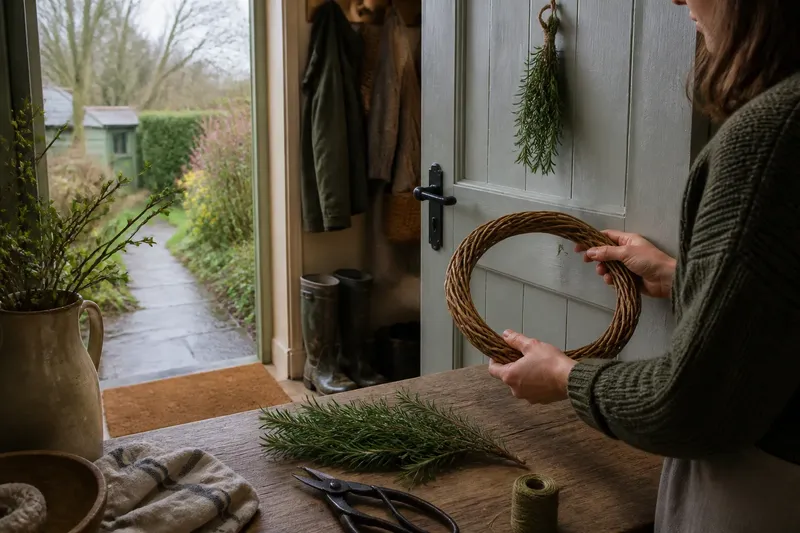
At the back door, a loop of willow still carries the faint bend of its winter storage. Someone sets it on the table beside clipped rosemary and pauses before tying anything in place. A spring doorway wreath begins with that small decision: what should the household notice as the season changes?
The wreath need not announce a grand celebration. Its materials, position and return to the door can make an ordinary threshold a marker of seasonal time. The right approach depends on the home: a sheltered entrance, a busy shared doorway and a quiet rural porch call for different choices. Treat the wreath as a household custom, not a test of craft or taste.
Choose by household
Start with the people who use the entrance and the way they pass through it. A front door seen by visitors may invite a more visible arrangement; a side door used for muddy boots may call for something robust and easy to move. The custom works when it belongs to the route people already take.
- For a household that marks the season together: If each person can reach the wreath safely, let everyone add one element; if not, have them choose materials while one person ties them in place.
- For a household with little time: If a reusable ring is easy to store, keep it plain and add a fresh sprig when convenient; if even that feels like a chore, leave the ring bare and use the seasonal cue without adding foliage.
- For a household with young children or pets: If loose berries, sharp stems or detachable pieces could be reached, place the wreath out of reach or omit those materials; if no safe position is available, choose a flat, firmly secured design or skip the hanging arrangement.
- For a household that prefers quiet observance: If one familiar material feels meaningful, use a pliable twig or evergreen clipping; if gathering material is inconvenient, use a plain base already at home.
- For a narrow or busy entrance: If the wreath would crowd the passage or catch on clothing, choose a shallow ring and secure it close to the door; if that still obstructs movement, place it indoors on a shelf.
- For a shared doorway: If household or building rules allow a door decoration that leaves the route clear, use a discreet hook; if permission is uncertain or the shared space would be affected, keep the wreath inside the home.
Say you have a narrow back entrance used by everyone returning from the garden. You begin with a pliable willow loop and a short rosemary sprig, then hold the loop against the inside of the door to check whether it catches a coat or blocks the handle. If it hangs clear, you tie the sprig firmly in place and expect a visible seasonal marker that does not crowd the passage; if it catches, you move it to a nearby shelf instead.
Let the doorway’s daily use decide the scale.
Read the materials
Materials carry different associations, but none has a universal meaning. Willow bends into a rounded form and can suggest renewal through its supple growth. Hazel twigs, dried grasses, evergreen clippings and fallen branches each bring a different texture and local character. A wreath made from what is familiar nearby can connect the season to the landscape without pretending that one regional custom belongs everywhere.
Consider the difference between gathered and purchased materials. Gathered material may recall a walk, a garden task or a particular tree; purchased stems may offer colour or a shape unavailable close to home. Either can suit the ritual. What matters is choosing with attention rather than treating materials as interchangeable decoration.
Fresh foliage changes as it dries. That change can be part of the wreath’s meaning: a bright green sprig may fade, curl or shed, showing the passage of the season rather than preserving a fixed spring image. If fallen leaves, grasses or seed heads are used, their texture may be more appropriate than a polished, uniform finish.
A practical material choice also accounts for the place it will hang. Damp weather can soften some plant matter; direct sun can dry it quickly. Where plant identification, harvesting permission or care instructions are uncertain, follow reliable local guidance and the supplier’s label. Choose materials that can be removed and composted or reused where appropriate.
Pick a material whose change you are willing to watch.
Place it with purpose
A wreath at the front entrance is visible to guests and neighbours, so it can act as a quiet invitation or a sign that the household has turned towards spring. On a kitchen door, it may speak chiefly to the people who live there. A porch or gate can make the gesture visible without placing it on the main door. The location changes the audience, and therefore the custom’s tone.
Think about how the door opens, where hands reach and what the threshold is used for. The wreath should not obstruct a handle, scrape against a wall or narrow a shared route. For a rented home or a building with communal rules, a freestanding hook or an indoor position may be more suitable than fixing anything to the door.
Placement can also distinguish the seasonal wreath from general decoration. Hanging it at the same entrance each spring creates continuity; moving it from a busy front door to a private kitchen door can make the practice more intimate. Neither choice is more authentic. The point is to give the change a place in the household’s ordinary geography.
If the wreath faces a covered porch, it can be more delicate. If it is exposed to wind and rain, a compact form with firmly attached elements is likely to remain tidier. Let the conditions of the threshold shape the design, not an image of an ideal doorway.
Make the ritual repeatable
A seasonal custom gains meaning through repetition, but repetition need not mean following a rigid calendar. A household might hang the wreath when the garden begins to stir, when evenings feel lighter, or when winter coats stop dominating the hallway. Pick a cue that people can recognise without needing a date to consult.
The making itself can be brief. Set out the base, choose a few materials, and let one person tie the first stem while another decides where the finished ring belongs. If the household is apart, one person can hang it and mention it at the next call. The practice can accommodate different routines without becoming a performance.
It helps to decide what will happen when the wreath is ready to come down. Some households keep the base for another season and compost suitable plant matter; others place the dried wreath in a garden corner or save a small element as a reminder. A clear ending prevents the object from becoming an unexamined fixture.
Keep the ritual small enough to repeat in a busy week.
Which approach fits?
What if the entrance is exposed to weather?
Choose a compact ring with sturdy, securely attached materials, or hang the wreath just inside a glass door. Fragile petals and loose decorative pieces may not suit a windy or rain-facing entrance.
Can a spring wreath be made without fresh flowers?
Yes. Willow, hazel, dried grasses, evergreen cuttings or a plain reusable base can mark the season without blooms. A single fresh sprig added later can become a small recurring gesture.
Where should a wreath go in a shared building?
Use a position that does not obstruct a corridor, door or common route, and respect the building’s rules. An inside-facing door or a shelf near the entrance can keep the custom personal without claiming shared space.
When should the wreath come down?
Let its condition or the household’s chosen seasonal cue decide. Removing it when foliage becomes brittle, untidy or no longer feels connected to spring gives the custom a natural close.
Keep its meaning local
A spring doorway wreath is not a universal emblem with a single fixed interpretation. Its meaning comes from the materials a household knows, the entrance it chooses and the moment it repeats the gesture. In one place, a bend of willow may recall a riverbank; elsewhere, the familiar sign of spring may be a branch from a garden hedge or a few stems saved from pruning.
That local quality is why copying a polished arrangement can feel less satisfying than using what is already part of the household’s surroundings. Ask what grows nearby, what the entrance can accommodate and what seasonal change the household actually notices. The answers need not be picturesque. A small arrangement can mark the first garden visit, the return of open windows or the move from wet boots to lighter shoes.
To make a spring doorway wreath meaningful, choose materials with a reason, place it where it fits daily life and repeat one modest action that signals the turn of the season. The most useful detail may be the one that is easiest to notice each time the door opens: a twig bending in the light, a familiar scent, or the moment someone remembers to take the winter wreath down.