The Useful Life of a Woven Market Basket
A woven market basket makes more sense when its fibre, shape and handles suit your shopping; learn how to choose, carry and care for one.
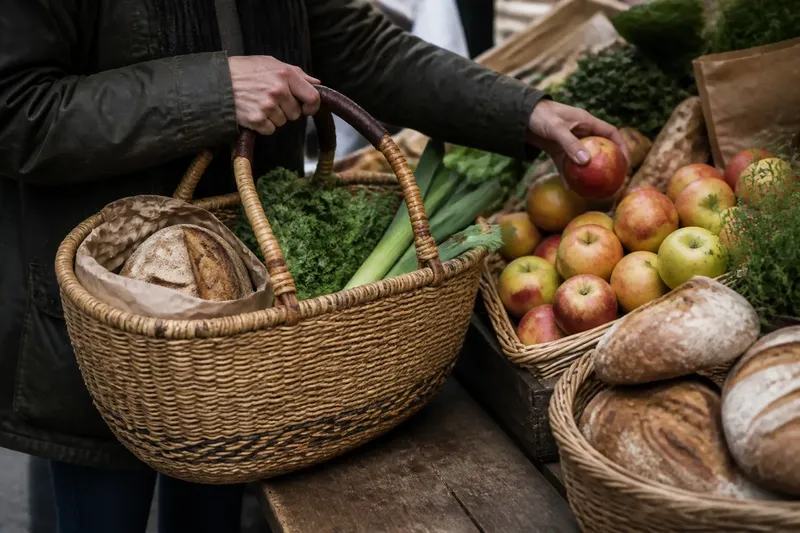
At a market stall, a shopper sets a woven market basket on the counter while choosing apples and a loaf. Its broad opening makes packing easy, but the basket’s usefulness depends on more than its appearance: the fibres, base and handles all need to suit the load and the walk home.
Fibres and finishes
Willow, rush, grass, reed, bamboo and palm can all be woven into baskets. Their qualities vary, and the local choice often reflects both what grows nearby and the techniques a maker knows. Rather than choosing by plant name alone, consider the intended load, the basket’s finish and any care guidance from its maker.
Look closely at the rim and joins. Ends tucked into the weave are less likely to catch clothing or loosen during ordinary handling. A smooth edge also gives your hand a more comfortable place to grip.
Notice whether fibres feel suited to what you plan to carry. If strands are rough or ends protrude, choose another basket or ask the maker whether the finish can be improved.
Shape and shopping
A wide mouth makes it easier to place leafy greens, flowers or bulky produce inside. A narrower opening can help contain smaller goods, but may make larger items awkward to retrieve. A flat, stable base is convenient on a stall counter or beside a doorway; a rounded base may sit less steadily on a level surface.
Consider how you will pack the basket as well as what it will hold. Put heavier, sturdier goods towards the base, and leave soft fruit or bread near the top. Keep lidded containers upright and avoid pushing oversized items against the sides.
Say you plan to carry a few firm vegetables and a paper-wrapped loaf on foot. You choose a basket with a broad base, moderate depth and handles that meet comfortably in one hand. The vegetables can sit low while the loaf remains easy to reach; a deep, narrow shape would make it harder to arrange and retrieve them.
Choose a shape that suits where you will set the basket down and how you will carry it.
Handles and balance
Two fixed handles can be carried in both hands, while a single loop may suit one-handed use. A shoulder strap leaves your hands free, though a narrow strap can press against the body. The right arrangement depends on the journey and the weight you expect to carry.
Check where the handles meet the basket. A handle woven into the sides or reinforced at its joins may feel more secure than one attached only to a thin rim. Lift the empty basket gently and notice whether it tips. Consider how unevenly packed goods might affect its balance.
If a grip feels rough or narrow in your hand, look for a smoother, more comfortable alternative, especially if you expect to carry the basket often.
Food and damp
An open basket makes it easy to add market purchases, but loose goods can shift or press against one another. A folded cloth or removable liner can separate delicate fruit from firmer items, as long as it does not hide loose strands or make cleaning difficult.
For dripping or muddy produce, use a washable container or suitable liner rather than placing it directly against the weave. Natural fibres can retain moisture or residue between strands. Follow the maker’s care directions, and let the basket dry fully after use.
Care between trips
Remove crumbs and leaves before putting the basket away. A soft brush can clear the weave without catching it. Let a damp basket dry in a well-aired place, away from direct heat, and store it where heavier objects will not crush its rim.
If a strand loosens, do not pull at it: pulling may widen the gap. A basket maker may be able to secure a small repair before nearby fibres shift. Look over the rim and handles now and then, particularly if you use the basket often.
Choosing a market basket?
Which fibre should I choose?
Willow, rush, grass, reed, bamboo and palm suit different weaving methods and uses. Choose according to the expected load, finish and care needs rather than relying on the plant name alone.
Can I carry wet produce?
Use a washable container or liner for muddy or dripping goods, then let the basket dry fully. Follow any care directions supplied by the maker.
How can I check its condition?
Look for a stable base, an even weave, a smooth rim and handles that feel firmly joined. If you see sharp ends, shifting strands or a pronounced tilt, choose another basket or ask its maker about repair.
Is a deeper basket more useful?
Depth can help contain loose items, but it can also hide small goods and make delicate produce harder to reach. Match the depth to your usual shopping and carrying habits.
A considered choice
A woven market basket is easiest to use when its material, shape and handles fit the ordinary journey from stall to home. Before choosing one, check its rim, base and joins, then picture the goods you actually carry. That small pause can help you leave with a basket that feels comfortable to handle and straightforward to care for.