A Slow Visit to a Covered Market on a Rainy Morning
A slow visit to a covered market on a rainy morning turns shelter, sound and layout into a simple route for noticing more without rushing.
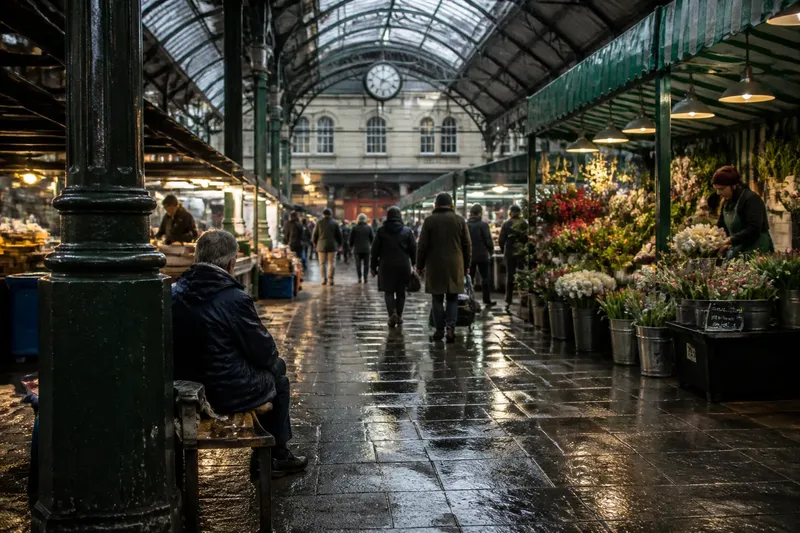
Rain ticks against the roof as you fold a damp umbrella beside the entrance. Inside, the paving is dark with footprints, and the first sounds are not voices but a trolley rattling over a joint and a shutter being lifted. A slow visit to a covered market on a rainy morning can begin with those small details, rather than a list of stalls to find.
The useful question is not how much of the market you can cover. It is what kind of attention suits the morning you have: a broad first circuit, a pause in one part of the hall, or a short route shaped by a sound or visual detail. Each approach reveals a different market, and none requires you to see everything.
Read the market’s structure
Before setting off, stand just inside the entrance and let your eyes adjust to the change in light. A covered market may be arranged around a central aisle, a cross-shaped passage, a courtyard or several connected rooms. Look for the clues that make the plan legible: a clock, a column, a painted sign, a stair, or a patch of daylight from a high window.
Rain makes the building easier to read. Wet coats and umbrellas gather near doorways; people tend to move along the driest or least crowded edges. Water may shine on the threshold and dull the floor farther in. Notice where the air feels warmer, where the roof lowers, and where a passage opens into a larger space. These changes suggest how the market is divided without requiring a map.
A broad first circuit suits a first-time visitor who wants orientation without committing to a long browse. Follow the edge of the hall, then cross the middle once, keeping a landmark in view. This gives you a rough sense of the market’s shape and lets you notice how its different areas meet. It is not a race to complete a loop; stop whenever a change in light, floor or noise catches your attention.
If the entrance is busy, step aside where you are not blocking the flow. A market has its own routes, and people carrying boxes or serving customers need room to pass. Keep your umbrella closed and turned down once you are indoors, and avoid stopping in a narrow doorway to consult your phone.
Choose a landmark before you move on.
Choose a pace
Three ways of spending the morning work especially well. The first is the orientation circuit: walk the outer edge and one cross-aisle, then decide whether to return to a particular section. It suits a visitor unfamiliar with the building, or someone arriving with a companion who likes to wander. Its strength is a sense of the whole; its weakness is that a brisk circuit can turn stalls into a passing blur.
The second is the anchored pause: choose a place to stand or sit, such as a public bench, a wide pillar or a café counter, and attend to the activity around it. This suits anyone who would rather observe than browse, or who has limited energy for walking. Watch how customers approach a counter, how a vendor arranges paper or crates, and how a small queue forms and dissolves. Stay out of working space, and ask before photographing people or their goods.
The third is the detail-led wander: follow one kind of feature through the building, such as lettering on stall signs, old tiles, baskets, roof supports or the sound of a bell. It suits a repeat visitor who already knows the main route, as well as someone who enjoys noticing materials and habits. The risk is getting absorbed in a detail and losing your bearings, so keep one familiar landmark in mind.
Say you arrive with an hour before a train and want to leave with a clearer sense of the place, not bags of provisions. You could make a short orientation circuit, pause by a pillar where the main aisle meets a side passage, then follow the changing roofline back towards the entrance. The observable result is a mental map with a few remembered sounds and details, rather than a hurried impression of every counter.
For a first visit, begin with the orientation circuit. If you are tired or travelling with someone who needs a rest, choose the anchored pause. If the market is familiar, let one detail lead you somewhere new.
Listen under the roof
A market’s sound changes across its rooms. Near a loading entrance, wheels and crates may set the rhythm; under a high ceiling, voices can blur into a general murmur. A narrow passage carries sharper sounds: a knife against a board, a bell at a counter, paper being folded around an order. Rain adds its own layer, sometimes audible on glass or metal, sometimes almost lost beneath conversation.
Try listening from one place before moving on. Separate what is steady from what comes and goes: ventilation, footsteps, a delivery trolley, a call from a stallholder. Then notice how the sound shifts when a door opens or a crowd thins. You do not need to identify every source. The point is to hear how the building and its working day meet.
People are not part of a performance, so keep observation discreet. A brief look at a busy counter is different from lingering over someone who is eating or working. If you want to record a sound or take a photograph, ask the person whose stall or conversation would be included.
Move to a quieter edge when the main aisle feels crowded.
Notice small details
Rain gives surfaces a temporary clarity. Look for the dark line where water has travelled across a threshold, the bright reflection of a sign on wet stone, or the trail of grit gathered near a doorway. Indoors, a repaired tile may differ slightly in colour from its neighbours; a pillar may carry layers of paint from earlier refurbishments. Such details tell you how the place is used and maintained, without turning the visit into a search for a single grand story.
Look at the working arrangements as well as the architecture. A stall may use chalk, card or a printed board for its sign. Produce might be arranged in shallow trays, with paper ready beside the till. At a flower counter, a bucket’s damp ring can mark where it has stood; at a bakery, a rack or cooling shelf may shape the route around the counter. These are ordinary traces, and their meaning is local to the stall. Notice what is visible without assuming why it is done.
One useful method is to choose a small category of detail and keep it modest: signs, surfaces, sounds or traces of rain. That gives attention a direction without turning the visit into a scavenger hunt. If you find yourself looking only through a phone camera, put it away for a while and let the scene settle in directly.
Rainy market questions?
What should I bring to a covered market?
Take a compact umbrella or a hooded coat, a bag that can be kept close, and a small notebook if you like to record observations. A closed umbrella is easier to manage indoors, especially in narrow aisles.
Is a rainy morning a good time to visit?
It can be a rewarding time to notice the building, reflections and changes in sound, though individual markets set their own opening hours and routines. Check the market’s public information before travelling, particularly if you are hoping to see a particular section open.
How can I avoid getting in the way?
Pause beside a wall, pillar or other clear space rather than in a doorway or directly in front of a counter. Keep bags and umbrellas close, and move on if workers need access to a passage.
Should I take photographs?
Architectural details and public spaces may be suitable subjects, but people and working stalls deserve consideration. Ask before photographing a vendor, a customer or a close view of someone’s goods, and accept a refusal without debate.
Let the morning decide
Choose your approach according to what the weather and the market are offering. If the entrance is clear and the building feels unfamiliar, take the orientation circuit. If the aisles are crowded or your energy is low, settle at an unobstructive edge. If you know the layout already, follow one small detail and see where it leads.
There is no need to turn the visit into a complete inventory. A few deliberate observations—a wet threshold, a roof changing height, a trolley’s uneven rattle—can give a slow visit to a covered market on a rainy morning its own shape. Before leaving, glance back towards the landmark you chose: it will help you find your way out, and may make the building feel more familiar the next time the rain brings you under its roof.